
WordsFlow
Create live links between Word documents and InDesign stories for seamless, on-going edits

- With WordsFlow, you create “live” links to source documents instead of normal, “dead” links that require re-doing all your work when changes are sent to you.
- WordsFlow breaks through your biggest editorial/production bottleneck — last-minute and on-going changes from your authors and editors — as well as enabling whole new workflows.
- When your authors & editors have changes in a live-linked document, and you update the link, WordsFlow “magic-merges” in their changes, with no loss of work on either side — particularly all your hard-won styling and editing.
- Now you can overlap production with ongoing and last-minute author/editor changes, shrinking time-to-publication dramatically, without requiring your collaborators to change their tools and workflows.


- WordsFlow was voted #4 in the 10 most valuable plugins for InDesign, and has been rock-solid in production use since 2013 at thousands of sites around the world — including the institutions above. Also see the glowing feedback from industry gurus.
- A trial takes (literally) 2 minutes to start and costs nothing—we guarantee you’ll be delighted.
- Read on for the full story, or use the top-of-page menu to jump directly to the relevant page section.
✻
✻
✻
The WordsFlow story
If you’re a visual learner, before we get into the full story, here’s a 4 minute walkthrough demonstrating the basics of WordsFlow.
Go “live” with Word/Excel
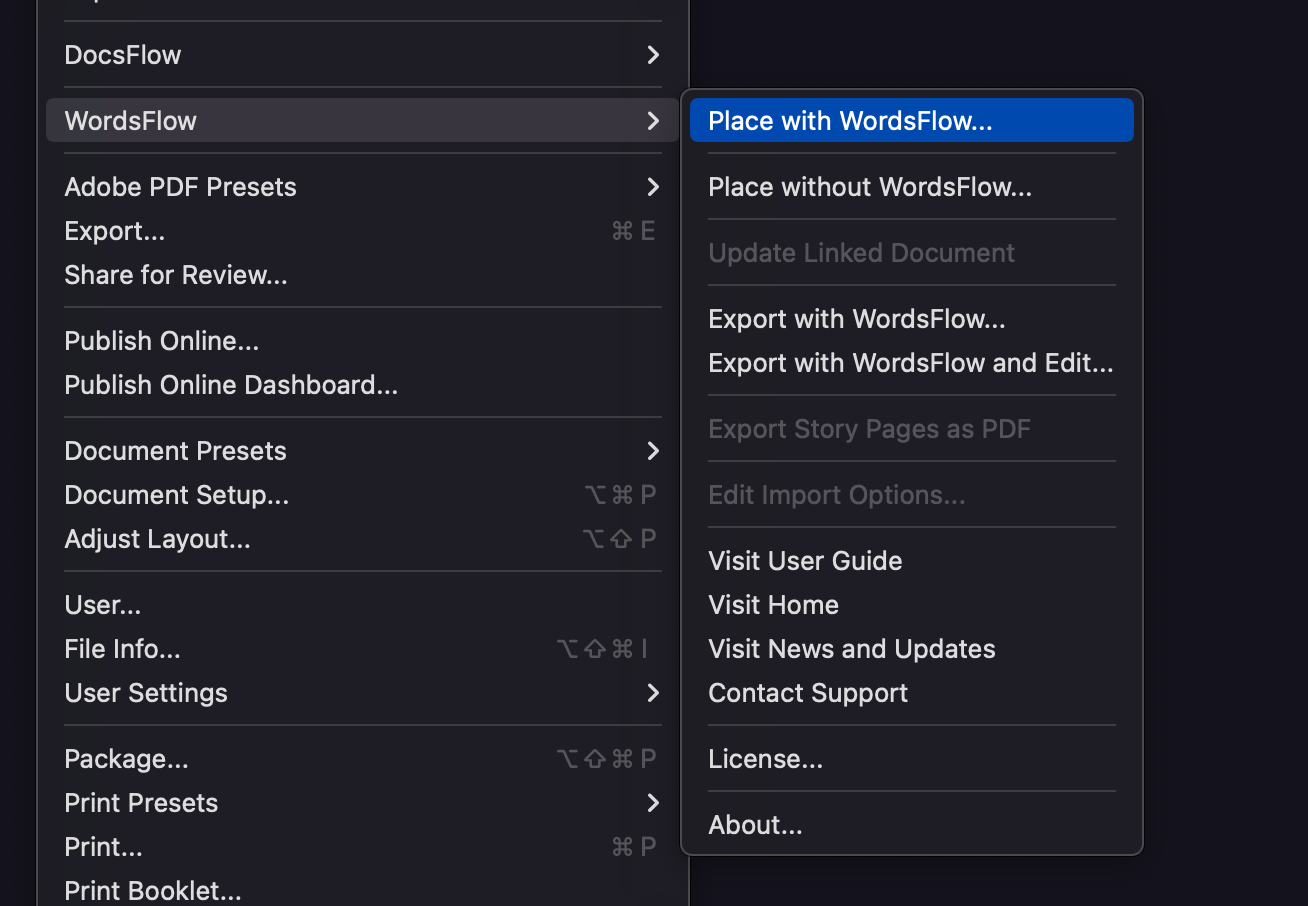
With WordsFlow, you place Word documents and Excel spreadsheets as InDesign story contents with File > WordsFlow > Place with WordsFlow, using a familiar Place-like dialog.
But, behind the scenes, WordsFlow maintains a “live” dynamic link so it can intelligently merge external document changes into the InDesign story contents on each link update, rather than just replacing the story and losing all your work.
So you can format, layout, and edit in InDesign, while your authors and editors continue creating and editing story content in Word and Excel, all without ever losing your work on updates. Your authors and editors are no longer “frozen out” once layout begins.
When using Word documents (not Excel), WordsFlow creates a two-way link so you can push your InDesign story changes back to Word format to provide your authors and editors with the latest content.
Your biggest headache?
If you use InDesign for production, you already know the pain point: an author sends you a story via email or file-sharing, and you’ve placed it in your InDesign publication, fixing typos, changing formatting, editing content as needed, etc.
Then, the author or your editor sends you another version of the file, and expects you to figure out what changed, and weave those changes into what you hoped was the final story.
In the past, you might bite your tongue and simply re-place the story, losing all your hard work, then go through and manually make all the same changes you made before, hoping you’re not forgetting something (and likely losing that bet).
Or, if you’re more sophisticated, you might use a file-difference utility or PDF markup, going through each change, manually editing the InDesign story to match, and scratching your head a lot. In either case, you end up wasting a lot of time in a highly error-prone process.
End the headache
When you place the original Word or Excel file (or any text file), WordsFlow asks InDesign to keep a special kind of dynamic link to the file.

When you or anyone else makes to changes to that file (locally or in a shared-file situation), InDesign will notice that the link’s source has changed, and change the link’s status to “modified” in the Links panel (a yellow alert icon, as shown here).
You can update the story when you’re ready, using the normal link-update invocations, such as a double-click on the modified icon, or selecting the Links panel menu item Update Link.
As the link update starts, WordsFlow kicks in. Instead of letting InDesign replace the linked story wholesale and losing all your work, it applies a complex algorithm behind the scenes to merge the changes made to the external document since the last update into the current InDesign story contents (and to detect any conflicts).
We call this the “magic merge-update,” since it seems like magic the first times you see it working. It’s this magic that frees you from endless error-prone manual merging.
Nothing to learn
With WordsFlow building on the standard file linking mechanisms you already know, there are no learning pains.
And there is no barrier to using WordsFlow—just install the plug-in, select Place with WordsFlow and proceed using the normal place dialog.
Your collaborators don’t need any special software, and can continue to work exactly as they always have. But now their last-minute or even ongoing changes won’t slow you down.
Two-way with Word

WordsFlow has two features that give you a fully two-way workflow with Word. You can push updates from any InDesign story to its linked Word document using File > WordsFlow > Update Linked Document. This way, you can keep your collaborators working with the latest InDesign content, in their own editing environment.
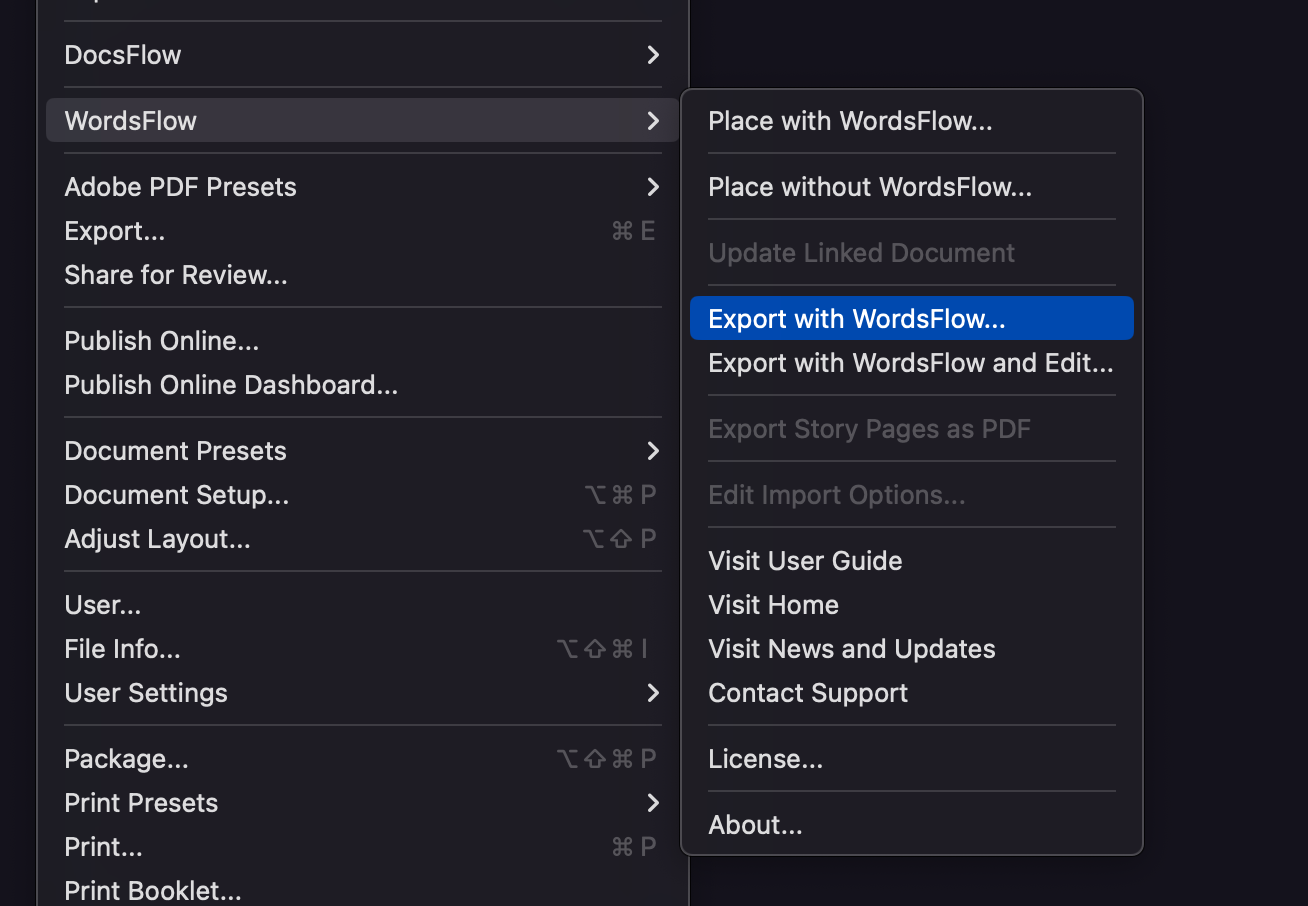
Additionally, WordsFlow can export original InDesign story content in Word .docx format, auto-linking to the result, using File > WordsFlow > Export with WordsFlow… So you can now take existing InDesign content—however it was produced—and push it out in Word format for further editing and revision, to be shared with your collaborators.
As they make additions and changes to the exported document, you can pull in those changes with a normal WordsFlow story link update—usually with just a double-click.
One-way with Excel
WordsFlow also works one-way with imported Excel spreadsheet files as well as Word files, since imported Excel sheets just turn into tables in InDesign. (We do continue to “piggy-back” on the Adobe Excel import filter for this feature.)
You can place a spreadsheet file as a story, then format columns/rows or individual cells, etc. in InDesign. Later, if you or someone else makes changes to the original spreadsheet, including editing cells, or moving around rows or columns, etc., WordsFlow will figure out what changed, and merge in the changes without losing the formatting and edits you’ve made in InDesign.
WordsFlow doesn’t support two-way workflow with Excel documents, since maintaining spreadsheet content in InDesign is nigh impossible. But we call it a “one and a half-way workflow,” since you can still work on both sides simultaneously.
New workflows
WordsFlow not only ends last-minute just-one-more-little-update kinds of headaches, it enables entirely new and powerful workflows.
You can now have authors maintaining their story content in Word, with the layout and production people keeping story links to the shared Word files in InDesign (or getting new copies and relinking to them). When authors make changes to the source files, the production folks can merge-update the WordsFlow-based links to bring in the changes.
That way, authors can stay working in their comfort zone, using Word and Excel, and production can maintain the overall document in InDesign, without worrying about hand-merging in the changes that happen over time.
For examples of other new workflows, think of a newspaper or magazine on deadline dealing with fast-breaking story updates. WordsFlow is the ultimate solution for last-minute changes before going to press.
Or, on a longer time frame, imagine a corporate or educational publication with multiple departments updating their respective sections regularly, or a quarterly financial prospectus assembling reports from various departments. The InDesign production folk can keep links to the multiple source files that comprise the whole publication, and the various departments can keep their work updated in Word. When go-to-press happens, the production folk can merge-update all the links after a “last call” for changes.
For a concrete example, see Laurie Ruhlin’s description of how she uses WordsFlow with clients—letting them maintain content control throughout the publishing process—in the WordsFlow reviews.
After the fact
If you’ve already placed and formatted a Word document without WordsFlow, and are presented with an updated Word document that threatens a massive amount of manual change merging, WordsFlow can still save the day.
With WordsFlow installed, use Link to Original, selecting the Word document that you originally placed before doing all the work in InDesign. Then, relink to the updated Word document, and, presto! the updated Word document changes are merged and all your editing and formatting work is saved.
Update/merge conflicts
Generally, if there are conflicts with content and formatting, the InDesign side “wins” for formatting, and the external document side “wins” for content.
But if there are real conflicts in content (e.g., both sides changing the same word or phrase), WordsFlow will leave InDesign story Notes at each conflict point, which you can review after an update and decide how to handle.
Importantly, right after you update a WordsFlow link, you can open the InDesign Story Editor to see what changed on both sides: the changes you’ve made since the document was placed or last updated, and the changes the author/editor made in the document. (Including any conflict notes.)
Best-in-class Word support
At some point, the built-in Adobe Word (.docx) import filter on which we “piggy-backed” became too much of a liability (too many bugs and instabilities that were making our customers unhappy and also making us look bad), so we developed our own much more robust .docx import filter.
And, of course, we had to develop our own .docx export filter for our two-way workflow since nothing like it existed.
Now that we have complete control over the whole import/export process, WordsFlow provides a much more stable and maintainable platform for your work with Word.
WordsFlow vs InCopy?
If you’re wondering how WordsFlow fares vs Adobe InCopy, they’re fairly different beasts. InCopy clearly wins for editing-to-fit.
But there are enough advantages to WordsFlow that we’ve written a separate comparison.
✻
✻
✻
What the experts say
David Blatner of InDesign Secrets was very excited about even the early initial release of WordsFlow.
I’m trying hard not to type phrases like “Most useful plug-in ever,” but I have to tell you: I’m sitting here with my mouth agape, heart beating faster, and thinking “This is what I’ve wanted for 20 years.” In short, I’m playing with WordsFlow, a plug-in from Em Software that fundamentally changes the way you’ll work with Word documents.
Jamie McKee of InDesign Magazine gave WordsFlow 3.0 a 5-star review. His conclusion:

WordsFlow 2 was already a terrific plug-in for InDesign. The addition of the new Word import filter introduced in WordsFlow 3 gives you unmatched style mapping abilities, even for locally formatted text, while maintaining its terrific linking and merging capabilities. If you spend a lot of time wrangling text files placed into InDesign, there’s no doubt that WordsFlow 3 will save you time and trouble.
Issue 137 of InDesign Magazine published a rundown of the ten most valuable plugins for InDesign, compiled from a survey of their board of experts. WordsFlow is #4 (and DocsFlow #8). Their pull quote:
Em Software’s WordsFlow is a no-brainer; I use it and couldn’t live without it. I used to send a PDF to my client, have her mark it up with PDF commenting, then spend a couple of hours deciphering her notes, scratch outs, word changes, and other tiny issues. Now, I send my client the exported Word file, and she makes all the minor changes. When she sends it back to me, I relink it with WordsFlow. The two hours that I would have worked on the minor changes is done in about a minute. —Laurie Ruhlin
Laurie also published a great overview of WordsFlow for the Adobe blog: InDesign editorial + production magic with WordsFlow. Her summary:
So there you have it. WordsFlow and DocsFlow (for Google Docs) allow my client to retain content control throughout the production process. They can use the program they feel comfortable in to make edits, and best of all, I “allow” them to do much of the tedious editing. I simply update or relink the Word file using WordsFlow, and instantly, those client changes are incorporated into my InDesign document. WordsFlow has greatly simplified my workflow and allowed me to keep my designer hat on, the one I love to wear!
✻
✻
✻
What users say
Here’s a sampling of the feedback we’ve received from WordsFlow users over the years. See WordsFlow testimonials for a whole page at a time.
(You can scroll through the testimonials in place using the previous/next-page arrows below. Click the title of any longer testimonial ending in “…” to see the rest.)
-
“WordsFlow is awesome!”
WordsFlow is awesome! I’ve never been able to get InDesign’s own document linking to work. WordsFlow is seamless and amazing. —Danny W.
-
“My team loves Wordsflow”
My team loves Wordsflow. The revision process while we create proposals is so much easier. —Seth McGinnis, Delve Underground
-
“I keep telling people how much I like working with your software”
Thank you so very much. I keep telling people how much I like working with your software! —Ana B.
-
“What an awesome program”
By the way, I just love WordsFlow! What an awesome program. —Katie K.
-
“thanks again for this software solution. Total lifesaver.”
…and thanks again for this software solution [WordsFlow, DocsFlow]. Total lifesaver. —Chris V.
✻
✻
✻
Try WordsFlow
Starting a trial is painless, taking only a few minutes, and giving you full-featured operation for 15 days at no cost. (Contact us if you need longer for a full evaluation.)
| WordsFlow 3.18.6 for InDesign 2026 | ⤓ macOS | ⤓ Windows |
| WordsFlow 3.18.6 for InDesign 2025 | ⤓ macOS | ⤓ Windows |
| WordsFlow 3.18.6 for InDesign 2024 | ⤓ macOS | ⤓ Windows |
- To download, find your InDesign major version and then your operating system above, and click the appropriate link.
- Once downloaded, quit InDesign if running, double-click the downloaded installer to install the plugin, then re-start InDesign. WordsFlow’s menu will be available at that point as a sub-menu of the File menu.
Then, to explore what WordsFlow can do, try the following.
- Use File > WordsFlow > Place with WordsFlow… to select a Word or Excel document to place and link. Choose Request Trial when prompted for a license.
- Make some styling changes to the InDesign story, and perhaps some content edits, then make some edits to the external document.
- Then, double-click the linked story’s yellow “link changed” warning icon in the Links panel to merge-update the external changes.
- Examine the resulting story, and see how changes on both sides are integrated by WordsFlow, and how any styling set in InDesign is maintained even if the contents are changed externally.
- Open the Story Editor to see exactly who changed what and where.
- Open the story Notes panel to see if there are any update-conflict notes left by WordsFlow.
Congratulations, you already know enough to start your long and productive journey with WordsFlow! When you need to know more, you can learn the details in the documentation.
We strongly encourage you to try out the software in your real-world environment before purchasing. Your just-installed and trial-activated WordsFlow plugin is a fully-functional version that will operate in trial mode for 15 days.
Also note that you can purchase a license at any point during the trial, and continue using WordsFlow without re-installing: once purchased, simply choose File > WordsFlow > About > License and enter your new license information, then OK your way out.
✻
✻
✻
Buy WordsFlow licenses
You can purchase subscription licenses—or just learn your localized cost should you purchase—via our online store. Prices start at 99 USD for 1 user / 6 months.
After a successful purchase, you will be shown a page with your new license(s), and will also receive an email with the same information. You should save a copy of this license information somewhere safe, because you’ll never be shown a full license again in the user interface (to protect you from casual piracy).
When prompted for a license on first use of the software (or when your trial has expired), copy and paste the license you received from the email or web page into the prompt, and enter your name, optional affiliation and email.
See our sales page for complete information about managing licenses, users, renewals, etc.
✻
✻
✻
Install or update WordsFlow
If you’re looking to install WordsFlow for a trial, see the trial instructions above.
The installer downloads below are the most up-to-date versions of WordsFlow. Use them in any non-trial situation—when you need either a fresh installation under a new or existing license or an update to the latest version for an existing licensed installation.
| WordsFlow 3.18.6 for InDesign 2026 | ⤓ macOS | ⤓ Windows |
| WordsFlow 3.18.6 for InDesign 2025 | ⤓ macOS | ⤓ Windows |
| WordsFlow 3.18.6 for InDesign 2024 | ⤓ macOS | ⤓ Windows |
- To download, find your InDesign major version and then your operating system above, and click the appropriate link.
- Once downloaded, quit InDesign if running, double-click the downloaded installer to install the plugin, then re-start InDesign. WordsFlow’s menu will be available at that point as a sub-menu of the File menu.
- On first use, you’ll be prompted to enter your license.
- If you’re waiting for your license to be purchased by someone, select Request Trial for the interim. Once you receive your license, open the plugin’s About > License dialog, enter that new license and verify your name, optional affiliation and email, then OK your way out.
- You can get going with WordsFlow very easily—see Getting Started in the user guide.
To use WordsFlow under older, unsupported versions of InDesign, or under the current InCopy versions, see all the WordsFlow installers.
For a reverse chronological release history, see all the WordsFlow news.
✻
✻
✻
Learn WordsFlow
WordsFlow has a full user guide, which we encourage you to dig into for all the details.
While WordsFlow is very easy to start using with just a basic understanding, it has a lot of powerful abilities that we cover in the guide—like style mapping, resolving conflicts, re-linking, and so forth.
Training
Anne-Marie Concepción of Seneca Design has released a course InDesign: Remote Workflows with InCopy, Word, and Google Docs on LinkedIn Learning, which includes two final chapters respectively on getting started with WordsFlow and DocsFlow. (The link gives you a 30-day free trial, which should be enough for the course.)
Nell Chitty has written a very helpful A Designer’s Love Letter to WordsFlow which includes recommendations for clients, best practices for Word users, and then a designer workflow based on WordsFlow. (Her note about the non-Pro version of WordsFlow isn’t a concern any more—all licenses are now Pro.)
✻
✻
✻
Get WordsFlow help
When you run into problems, please follow these directions.
- First, make sure you’re running the very latest version of the plugin—the current versions are found in the Install or update section above. If not, please install the latest version and try again (you’ll have to restart InDesign)—many issues are solved at this point.
- Second, check the Troubleshooting section of the user guide.
- If those don’t help, then start a support ticket using File > WordsFlow > Contact Support, which fires up your default email application with critical information we’ll need to be of any help.
- Write a concise summary of the problem in that email, including the steps to reproduce.
- Normally, we’ll have to see your documents (InDesign and Word/Excel), so zip up the documents in question and attach them to the email you’re composing. This doesn’t necessarily have to happen at the first submission, so don’t send yet if you’re not sure. (We’ve been handling confidential customer information for 35 years without a single problem, so you can rest assured your data is in good hands.)
- Send the email (which goes to support@emsoftware.com).
If you have a sales-related or license-related question, first see sales & license information, and if that doesn’t help, send a normal email to sales@emsoftware.com.
✻
✻
✻
Follow WordsFlow news

(You can scroll through the news items in place using the previous/next-page arrows below. Click the title of any news item to view the content.)
-
Release: WordsFlow 3.18.1 for InDesign 2024-2026
This patch addresses an incompatibility with Adobe’s InDesign 2026 21.2 release.
-
Release: WordsFlow 3.18 for InDesign 2024-2026
This release mainly addresses an incompatibility with Adobe’s InDesign 2026 21.1 release.
-
Release: WordsFlow 3.17.1 for InDesign 2024-2026
This patch fixes link updates of LibreOffice Writer files.
-
Release: WordsFlow 3.17 for InDesign 2024-2026
This release adds support for InDesign 2026.
-
Release: WordsFlow 3.16.2 for InDesign 2023-2025
This patch fixes unexpected “Edits have been made…” warnings given by the 3.16.1 release.